By Shanjid Shane 🕒 Jun 6, 2026
China’s Ambitious Plan to Build the World’s Largest Astronomy Base on a Remote Tibetan Mountain
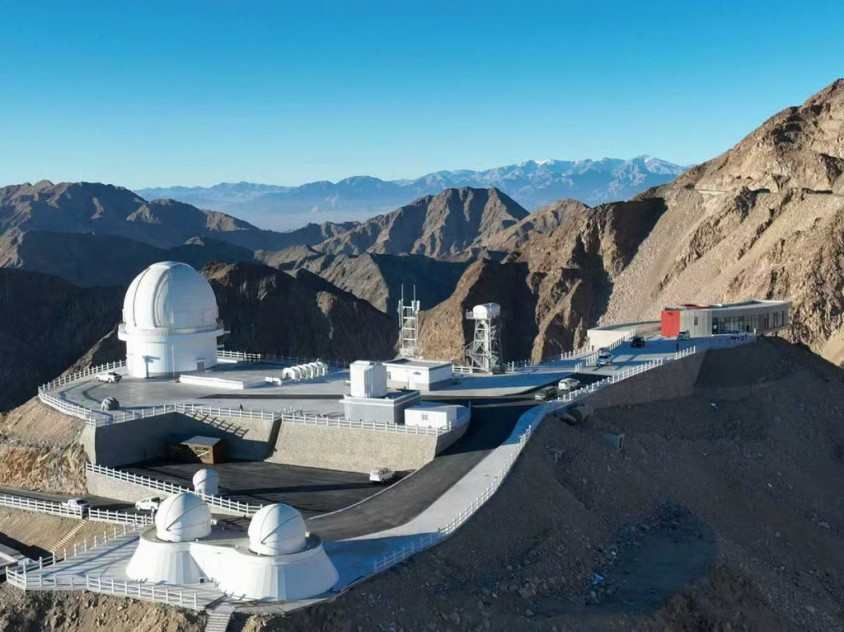
China is transforming Saishiteng Mountain into the world’s largest astronomy base by the mid-2030s, featuring powerful telescopes and cutting-edge research.
China is accelerating plans to transform Saishiteng Mountain on the Tibetan Plateau into what scientists say could become the world’s largest astronomy base by the mid-2030s.
The ambitious project, located near the remote town of Lenghu in Qinghai Province, aims to bring together some of the most advanced optical telescopes ever built in Asia. Researchers involved in the effort say the site’s unique geography and climate make it one of the best locations on Earth for observing the universe.
Construction is already underway on several major telescope projects, while additional facilities are being planned as part of a long-term strategy to establish a world-class astronomy hub in western China.
Why Saishiteng Mountain Matters
At first glance, Saishiteng Mountain appears to be an unlikely location for a scientific megaproject. Rising more than 4,200 meters (13,800 feet) above sea level, the region is isolated, cold, and difficult to access.
Yet these harsh conditions are exactly what astronomers are looking for.
The mountain sits in one of the driest regions of China, far from major cities and sources of light pollution. The thin atmosphere and stable weather patterns allow telescopes to capture exceptionally clear images of distant stars, galaxies, and cosmic events.
A landmark study published in 2021 found that the observing conditions at Lenghu rival some of the world's most famous astronomy sites, including those in Chile and Hawaii.
"The quality of the sky here is among the best measured anywhere in the world," researchers noted during the site evaluation process.
China’s Vision: Building the World’s Largest Astronomy Base
Unlike traditional observatories that focus on a single telescope, China is pursuing a different model.
Scientists and government agencies are creating an astronomy cluster where multiple observatories, research centers, and scientific institutions operate together at one location.
According to project scientists, construction of some of Earth's most powerful optical telescopes is putting China on track to host the world's largest astronomy base by the middle of the next decade.
Several major facilities have already been established or are under development, with more expected to follow.
The goal is not only to increase China's scientific capabilities but also to create a global center for astronomical research that can operate for decades.
Major Telescope Projects Taking Shape
Mozi Wide Field Survey Telescope (WFST)
One of the most significant projects already in operation is the Mozi Wide Field Survey Telescope.
Designed to scan vast areas of the night sky, the telescope helps scientists detect asteroids, supernovae, variable stars, and other transient cosmic events that require rapid observation.
Researchers compare its role to a cosmic search engine, identifying targets for larger telescopes to investigate in greater detail.
Jiaotong University Spectroscopic Telescope (JUST)
Another key project is the 4.4-meter Jiaotong University Spectroscopic Telescope, known as JUST.
Unlike survey telescopes that primarily take images, JUST will analyze the composition and movement of celestial objects by studying their light spectra. Scientists hope the facility will contribute to research on exoplanets, galaxy evolution, and the chemical history of the universe.
Multiplexed Survey Telescope (MUST)
The planned 6.5-meter Multiplexed Survey Telescope is expected to become one of the largest instruments at the site.
Researchers believe it could play an important role in studying dark energy, gravitational-wave events, and large-scale cosmic structures.
Filling a Critical Gap in Global Astronomy
Scientists say one of the strongest advantages of the Saishiteng project is its location.
Most of the world's leading optical observatories are concentrated in the Western Hemisphere, particularly in Chile, Hawaii, and the Canary Islands.
A major astronomy hub in western China would help fill a significant geographical gap in global observation networks.
This could allow astronomers to monitor fast-changing events across the universe more continuously as Earth rotates, improving the ability to track supernova explosions, black hole mergers, and other short-lived phenomena.
More Than Science: A Strategic Investment
The project also reflects China's broader investment in advanced science and technology.
Large telescope programs often drive innovation in precision engineering, optics, data processing, artificial intelligence, and advanced manufacturing.
Experts say the development of a world-class observatory network could strengthen China's position in global scientific research while reducing dependence on overseas facilities.
The initiative aligns with the country's long-term efforts to expand its capabilities in space exploration, fundamental physics, and high-technology industries.
Challenges on the Roof of the World
Despite its scientific advantages, building on the Tibetan Plateau presents major logistical challenges.
Workers and researchers must operate in an environment with low oxygen levels, freezing temperatures, and rugged terrain. Transporting sensitive equipment to high-altitude construction sites requires extensive planning and infrastructure investment.
To support future growth, authorities have invested in roads, communications networks, power systems, and research facilities connected to the Lenghu region.
Scientists say this infrastructure will be essential if the observatory complex continues expanding over the coming decade.
The Future of Astronomy in Asia
If current plans proceed as expected, Saishiteng Mountain could become one of the most influential astronomical research centers in the world.
By the mid-2030s, the site may host a diverse collection of optical, infrared, solar, and spectroscopic telescopes operating together in a single scientific ecosystem.
For many astronomers, the project represents more than a national achievement. It signals the emergence of a new global center for exploring the universe.
FAQ
What is Saishiteng Mountain?
Saishiteng Mountain is a high-altitude site near Lenghu in Qinghai Province, China. It has been identified as one of the world's best locations for astronomical observations.
Why is China building an astronomy base there?
The site offers dark skies, dry air, high elevation, and stable atmospheric conditions, making it ideal for powerful telescopes.
When could it become the world's largest astronomy base?
Project scientists say the observatory complex could become the world's largest astronomy base by the mid-2030s if planned telescope projects are completed.
What telescopes are being built at the site?
Major projects include the Mozi Wide Field Survey Telescope (WFST), Jiaotong University Spectroscopic Telescope (JUST), and Multiplexed Survey Telescope (MUST).
How does the project compare with observatories in Chile?
While Chile remains home to many of the world's largest observatories, China's Saishiteng project aims to create a similarly large astronomy cluster in the Eastern Hemisphere.
Stay Ahead of the News
Before Everyone Else
Major stories break every hour. Join our news community and receive instant alerts, viral headlines, and important updates the moment they happen.